
Video of the ship colliding with the Baltimore bridge proves the bridge collapse wasn’t “an accident.”

Baltimore bridge collapse: Federal, state officials say ship’s collision wasn’t intentional

If your time is short
-
Federal and Maryland officials have said there is no credible evidence the Dali ship’s collision with the Francis Scott Key Bridge in Baltimore was intentional. Officials have called it "an accident."
-
Preliminary reports show the ship’s crew made efforts to slow the vessel and prevent contact with the bridge. The pilot also issued a mayday call to stop traffic on the bridge.
- No spin, just facts you can trust. Here’s how we do it.
Social media users are sharing an accelerated video of a cargo ship colliding with Baltimore’s Francis Scott Key Bridge and claiming it proves the crash was intentional.
A March 26 Facebook reel shared this video with text above it that read, “8x speed really exaggerates how sharp the Dali turned just before striking the bridge.” Dali is the Singapore-based vessel that struck the Key Bridge on March 26.
As the footage plays, a person in the video says, “You can’t tell me this looks like an accident. I mean, take a look at the angle in which it takes in order to hit that bridge.”
The video has been shared multiple times on Facebook and Instagram. These posts were flagged as part of Meta’s efforts to combat false news and misinformation on its News Feed. (Read more about our partnership with Meta, which owns Facebook and Instagram.)
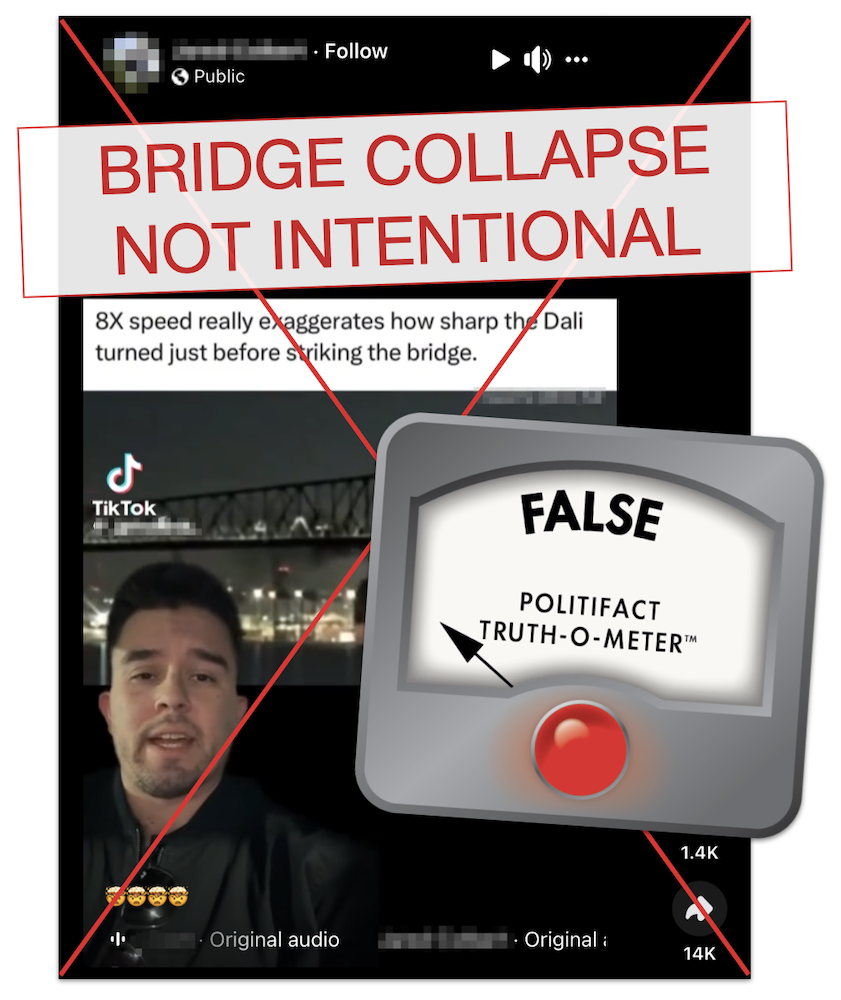
(Screengrab from Facebook)
Federal and Maryland officials said they do not think the cargo ship’s crash into the bridge’s support column was intentional. Officials have referred to the event as an “accident.”
During a March 26 press conference, Gov. Wes Moore, D-Md., said, “The preliminary investigation points to an accident. We haven’t seen any credible evidence of a terrorist attack.”
During the same press conference., William J. DelBagno, the special agent in charge of the FBI’s Baltimore field office, said, “I want to be clear that there is no specific or credible information to suggest there are ties to terrorism in this incident.”
President Joe Biden said during a different March 26 press conference, “This was a terrible accident. At this time, we have no other indication, no other reason to believe there is any intentional act here.”
Before the collision, the Dali had a “complete blackout,” meaning it lost engine and electrical power, Clay Diamond, executive director of the American Pilots’ Association, a national trade association for maritime pilots, told The Washington Post, The New York Times and CNN. (The National Transportation Safety Board is still investigating the extent of the ship’s power loss.)
In the collision footage, the ship’s lights turn on again after the power outage. Diamond told news outlets that was likely the ship’s backup generator activating.
When the ship lost power, the pilot did “everything that he could have done” to slow down the ship and prevent it from drifting right toward the bridge, Diamond told CNN.
The ship’s pilot ordered his crew to turn the Dali’s rudder hard left and drop the ship’s left anchor, Diamond said. The pilot also issued a mayday call, warning officials to close the bridge off from traffic.
“Those were all the appropriate steps, but it happened so quickly and with so little lead time,” Diamond told CNN. “Neither one of those maneuvers were enough.”
About five minutes passed from the time the first alarms sounded to when the 984-foot-long Dali, weighing 112,000 gross tons, or about 248 million pounds, crashed into the bridge. It’s unclear what triggered the alarms. The National Transportation Safety Board, an independent federal agency, is leading the investigation into the incident, which started March 26.
The agency initially obtained about six hours of footage from the Dali’s voyage data recorder, or VDR, which contains a “snapshot of the major systems on a vessel,” National Transportation Safety Board Chair Jennifer Homendy said during a March 27 press conference.
By regulation, the voyage data recorder must record 30 days of the ship’s history. The Dali’s data included audio recordings and information about ship speed, engine rotations per minute, rudder angle, ship heading and alarms.
The board will obtain more data as the investigation continues. But based on preliminary data, the board built a timeline of events preceding the crash:
-
At 12:39 a.m., the ship left Seagirt Marine Terminal in the Port of Baltimore.
-
At 1:07 a.m., the ship entered the Fort McHenry Channel, traveling toward the Francis Scott Key Bridge.
-
By 1:24 a.m., the ship was traveling at about 9 miles per hour.
-
At 1:25 a.m., numerous alarms sounded on the ship. The ship’s voyage data recorder stopped recording system data but audio recordings continued.
-
At 1:26 a.m., the voyage data recorder resumed recording the ship’s system data. Audio recordings showed steering commands and rudder orders were made. Around the same time, the ship’s pilot called for tugboats to return and help the Dali.
-
At 1:27 a.m., the Dali’s pilot ordered the left anchor to be dropped and issued additional steering commands.
-
About 20 seconds later, the pilot made a radio call that the Dali had lost power and was approaching the Key Bridge. The Maryland Department of Transportation instructed officers to stop traffic from crossing the bridge.
-
At 1:29 a.m., the ship was traveling at about 8 miles per hour when the voyage data recorder reported sounds consistent with the bridge collision. Dashboard cameras showed the bridge’s lights go out.
-
A few seconds later, the ship’s pilot reported the Key Bridge was down.
Our ruling
Social media users are claiming video of the ship colliding with the Baltimore bridge proves it wasn’t “an accident.”
Federal and state officials’ preliminary reports say there is no credible evidence the bridge collision was intentional and have repeatedly called it “an accident.”
Audio recordings and other information from the ship show the crew tried to slow the vessel and prevent contact with the bridge. The pilot also issued a mayday call to stop traffic on the bridge.
We rate this claim False.
RELATED: Baltimore bridge collapse: A cyberattack, a movie and other false claims about the ship accident
Our Sources
Facebook reel (archived), March 26, 2024
Instagram reel, March 27, 2024
Facebook reel, March 27, 2024
YouTube, "WGAL-TV - Baltimore bridge collapse: Full news conference," March 26, 2024
YouTube, "The Associated Press - LIVE: Biden addresses Baltimore bridge collapse," March 26, 2024
YouTube, "NTSB Media Briefing - Francis Scott Key Bridge struck by Cargo Ship Dali," March 26, 2024
YouTube, "NTSB Media Briefing 2 - Francis Scott Key Bridge struck by Cargo Ship Dali," March 27, 2024
National Transportation Safety Board Newsroom, X post, March 27, 2024
National Transportation Safety Board Newsroom, X post, March 27, 2024
National Transportation Safety Board Newsroom, X post, March 27, 2024
National Transportation Safety Board Newsroom, X post, March 27, 2024
National Transportation Safety Board Newsroom, X post, March 27, 2024
National Transportation Safety Board Newsroom, X post, March 30, 2024
The New York Times, "The Five Minutes That Brought Down the Francis Scott Key Bridge," March 27, 2024
The Washington Post, "Pilot on board the Dali tried to slow ship before it struck Key Bridge," March 26, 2024
CNN, "6 presumed dead in Maryland bridge collapse; Dali cargo ship lost power before collision," March 27, 2024
CNN, "What we know about the Baltimore bridge collapse," March 29, 2024
The Associated Press, "Baltimore Key bridge collapse live updates: Two bodies recovered, authorities say," March 27, 2024
PolitiFact, "Baltimore bridge collapse: A cyberattack, a movie and other false claims about the ship accident," March 27, 2024