
“Over 65% of the country believes that (the) 2020 election was fraudulent. That number was around 35% a year ago.”
No, most Americans don’t believe the 2020 election was fraudulent

If your time is short
-
In several surveys conducted after November 2020, a majority of Americans said they believe the presidential election was free and fair. However, many Republicans still view Joe Biden’s victory as fraudulent.
Claims that the 2020 election was fraudulent have been repeatedly disproven through exhaustive audits, recounts, reports and reviews. But is it true that more than 65% of the nation still believes the narrative has merit?
No. But a widely shared Facebook claim asserts just as much:
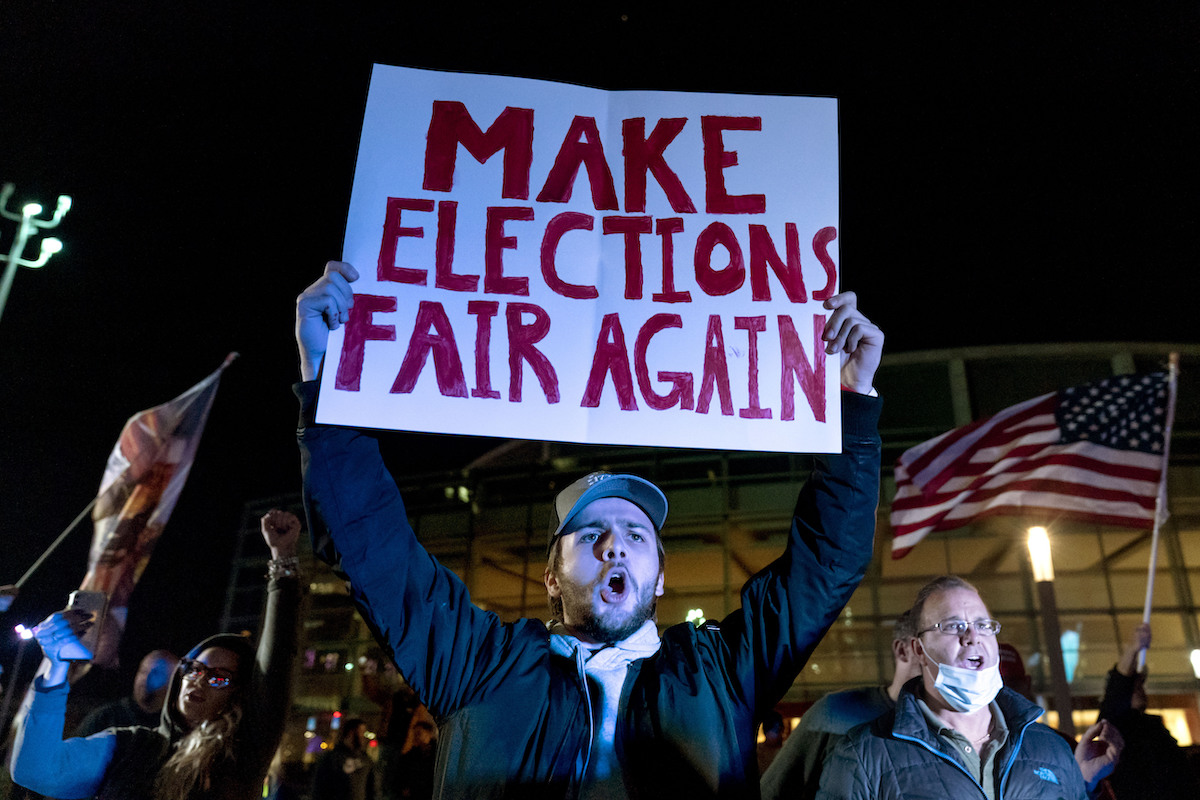
“Over 65% of the country believes that (the) 2020 election was fraudulent. That number was around 35% a year ago,” the Jan. 30 post claimed in words above a photo.
This post was flagged as part of Facebook’s efforts to combat false news and misinformation on its News Feed. (Read more about our partnership with Facebook.)
We reviewed 14 surveys that fleshed out polling on Americans’ attitudes about the 2020 election outcome and found none that back up this claim. However, surveys examining public sentiment around the 2020 election showed a clear partisan divide. Democrats typically believed there was no widespread voter fraud and Biden’s win was legitimate, while Republicans overwhelmingly said they doubted the election’s legitimacy.
In at least three surveys we found, the percentage of Republicans who said they didn’t trust the election came in around 65%.
The number of people overall who believe the election was fraudulent has hovered around 35% since November 2020, but this percentage has not increased significantly as the claim purports.
The surveys
A number of surveys examined public sentiment following the election. Here are a few with findings relevant to the claim:
-
Two Associated Press-NORC Center for Public Affairs Research polls conducted in February and July 2021 found that two-thirds of Republican respondents believe Biden was illegitimately elected in 2020.
-
A January 2021 Morning Consult survey of 1,990 registered voters nationwide showed 65% responded that they believe the 2020 election was “free and fair.” But when those results were broken down by party affiliation, only one-third of Republicans were in agreement with that statement. When asked what sources helped lead them to believe the election was fraudulent, a majority of Republicans cited former President Donald Trump, who has repeatedly claimed without evidence that his loss was not legitimate.
-
A December 2021 poll of 1,000 adults conducted by the University of Massachusetts Amherst and YouGov, found that 58% of all respondents believed Joe Biden’s victory in the 2020 election was legitimate. Only one-third of respondents said it was not legitimate. Of those who view the election as illegitimate, 83% named “fraudulent ballots supporting Joe Biden” as the reason for their belief.
-
Another December 2021 poll, this one conducted by the Washington Post and the University of Maryland, asked 1,101 adults: “Regardless of whom you supported in the 2020 election, do you think Joe Biden’s election as president was legitimate, or was he not legitimately elected?” Nearly 7 in 10 respondents said Biden was legitimately elected, while 29% said he was not.
-
A Quinnipiac University poll conducted one month after the November 2020 election found similar results. Six in 10 respondents said Biden’s win was legitimate, versus 34% who said it was not legitimate. A majority of respondents in the Quinnipiac poll also said they did not believe there was widespread voter fraud in the 2020 presidential election, whereas 38% said they did believe there was fraud.
-
When Quinnipiac conducted a second poll six months after the election, the number of respondents who believed the election to be legitimate increased to nearly two-thirds. Respondents who said the contest was illegitimate dropped to 29%.
Despite Trump’s claims of voter fraud, no evidence of widespread voting malfeasance has been found in the several reviews and audits of the 2020 election conducted by the federal government, state officials, election security experts and news organizations. PolitiFact has also fact-checked more than 80 misleading or false claims about voter fraud in the 2020 election.
Our ruling
A Facebook post said, “Over 65% of the country believes that (the) 2020 election was fraudulent. That number was around 35% a year ago.”
More than a dozen public opinion surveys found that a majority of Americans overall believe the results of the 2020 election were legitimate. However, many of these polls also found that many Republicans continue to hold the view that the results were skewed by voter fraud, despite a lack of evidence.
We rate this claim False.
Our Sources
Facebook post, Jan. 30, 2022
University of Massachusetts Amherst and YouGov poll, Dec. 28, 2021
Quinnipiac University poll, Dec. 10, 2020
Quinnipiac University poll, May 26, 2021
MarketWatch, "Poll finds 65% of Republicans say they don’t believe Biden’s election was legitimate," Feb. 5, 2021
Associated Press, "AP-NORC poll: Many Republicans uneasy about party’s future," July 27, 2021
Morning Consult poll, Jan. 27, 2021
PolitiFact, "Fact-checking false claims about the 2020 election," Nov. 19, 2020
Associated Press, "Disputing Trump, Barr says no widespread election fraud," Dec. 1, 2020
USA Today, "Fact check: No evidence of fraud in Georgia election results," June 1, 2021
Brennan Center for Justice, "It’s Official: The Election Was Secure," Dec. 11, 2020
Associated Press, "Far too little vote fraud to tip election to Trump, AP finds," Dec. 14, 2021
Washington Post and University of Maryland poll, Jan. 1, 2022
Axios-Momentive poll, Jan. 3, 2022
Axios-Momentive poll, May 21, 2021
Axios-Momentive poll, Jan. 5, 2021
CNN poll, Sept. 15, 2021
Pew Research Center poll, Jan. 15, 2021
Reuters-Ipsos poll, May 21, 2021
Monmouth University poll, March 17, 2021