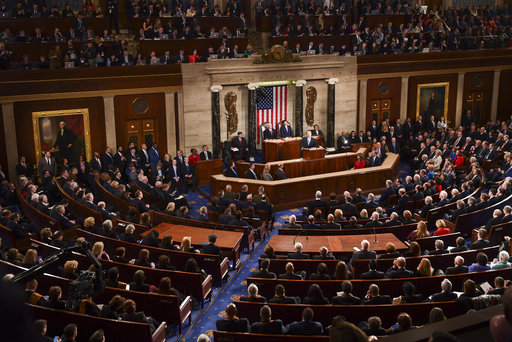
President Donald Trump touted economic achievements on his watch during his State of the Union address. One of the statistics he cited was wage growth.
“After years of wage stagnation, we are finally seeing rising wages,” Trump said.
However, that’s problematic in two ways.
We asked Jed Kolko, the chief economist at the jobs site Indeed.com, for the best measure to use, and he said it was median usual weekly real earnings for full-time wage and salary workers, 16 years and over. This is a measure that tends to reflect the typical wages of people with stable employment and it is adjusted for inflation.
This figure has been calculated quarterly since 1979. Here’s the full run of the data:
This data shows that after Trump entered office, wages initially went up, then fell. For the fourth quarter of 2017, the figure was $345. That’s slightly below the $349 mark in the fourth quarter of 2016, before Trump entered office.
Even if you allow for some quarterly blips, however, Trump’s statement is also misleading in another way. The “years of wage stagnation” he refers to didn’t end with Trump’s presidency — wage growth began under President Barack Obama.
Wages hit their post-Great Recession low in the second quarter of 2014, at $330. They climbed, with just a few blips, for the rest of his presidency.
When we asked the White House for data, they said, incorrectly, that the most recent data was from the third quarter of 2017.
The White House also offered another statistic: average real weekly earnings of all private-sector employees.
For this statistic, wages have indeed risen since Trump has been in office — by less than 1 percent from December 2016 to December 2017. But here, too, wages rose over the equivalent periods of time in 2013, 2014, 2015 and 2016, in one case by as much as 2 percent over the course of a year. So it’s incorrect to say the United States is “finally” seeing wage increases.
Our ruling
Trump said, “After years of wage stagnation, we are finally seeing rising wages.”
By the most common measure, wages did go up for the first three quarters of Trump’s presidency, but they fell in the fourth, wiping out all the gains on his watch and then some. And even if you ignore this fourth quarter figure as a blip, his assertion ignores that wages — by two different measurements — began their climb during the final years of Obama’s presidency.
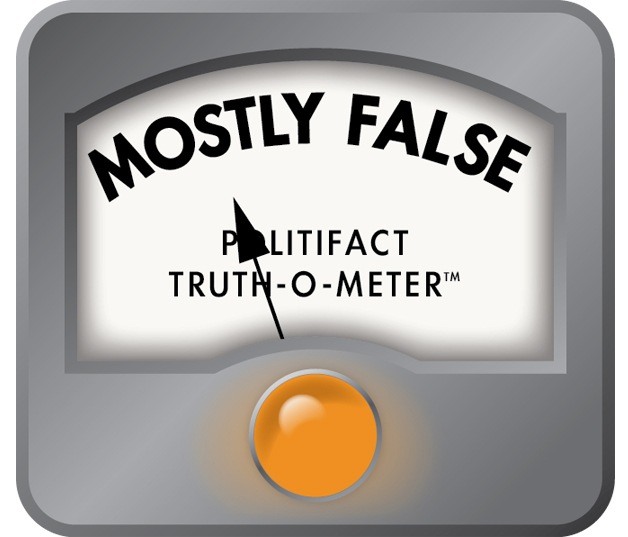
We rate his statement Mostly False.

 PolitiFact Rating:

Truth-o-meter Ruling
Statement
"After years of wage stagnation, we are finally seeing rising wages."
Context
his State of the Union addressSpeaker/Target
Statement Date
Our Sources
Donald Trump, State of the Union address, Jan. 30, 2018
Federal Reserve Bank of St. Louis, "Employed full time: Median usual weekly real earnings: Wage and salary workers: 16 years and over," accessed Jan. 30, 2018
Email interview with Jed Kolko, chief economist at Indeed.com, Jan. 30, 2018