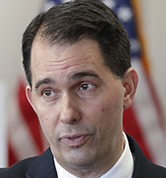
Governor-elect Scott Walker says Milwaukee-to-Madison high-speed rail line is dead
After weeks of discussion, maneuvering and protests, Governor-elect Scott Walker is taking a sharp new tack on the proposed Madison-Milwaukee high-speed rail link.
Walker transition director John Hiller issued this statement Nov. 18, 2010: “The Madison-Milwaukee train line is dead.”
It was quoted in the JSOnline story headlined “Rail backers turn up heat on Walker” and repeated on television, and again several days later in USA Today.
Hiller may as well have quoted directly from Meinhardt Raabe, the late Jefferson County, Wis., actor who played the Munchkin coroner in the “Wizard of Oz”:
“As Coroner I must aver, I thoroughly examined her. And she’s not only merely dead, she’s really most sincerely dead.”
At issue, of course, is the $810 million federal grant the state sought and won to extend Amtrak service from Milwaukee to Madison. The project is to be one link in a Midwest network of new high-speed rail service. Walker argues the state can not afford the operating expense of the train and has vowed to kill the project.
As recently as Nov. 10, Hiller put it all in the future tense: “Governor-elect Scott Walker is going to fulfill his campaign promise to stop the construction of the Madison-Milwaukee train line.”
So what changed? Is the train really most sincerely dead even before Walker takes office?
First, although it was Hiller who made the comment, he’s a Walker appointee. When we followed up with Walker’s office, transition spokesman Cullen Werwie simply repeated the statement. As such, we’ll treat it as a statement from Walker himself.
In many ways, the comment recalls one made by U.S. Transportation Secretary Raymond LaHood, who declared at a Labor Day rally in Milwaukee: “It’s coming. Nobody can stop this train.”
It was stated as fact, not an opinion or promise or prediction of the future. We looked at that statement and ruled it False, noting there were many ways Walker, once in office, could kill the project.
The key, of course, was once in office. And that happens Jan. 3.
In the meantime, there are plenty of people — including President Barack Obama — who support this project. And, if anything, the public discussion has recently centered on finding a way to answer one of Walker’s chief objections: the annual state subsidy to operate the train.
That subsidy has been estimated at anywhere between $750,000 and $7.5 million, depending on whether the feds pick up the vast majority of the cost. LaHood’s office declined to discuss the matter with us.
Among the things that could still happen:
An outside group could cover the operating shortfall: Madison Mayor David Cieslewicz has said the city might be willing to help with the operating costs, noting his city’s chamber of commerce and other business groups support the project.
“We’re willing to take a look at some of the operating expenses,” said Cieslewicz aide Chris Klein. “If that’s the issue, we’re willing to help.”
So far, there’s no action taken by the Madison City Council on the matter, but the mayor is willing to “sit down and have a conversation about it,” said Rachel Strauch-Nelson, communications director.
Congress could take a new look at it: U.S. Rep. Tom Petri (R-Wisconsin) supported the train for years because that was the wish of Democratic Gov. Jim Doyle and his predecessor Republican Gov. Tommy G. Thompson. But then Petri backed away from it after Walker won. (That earned a Full Flop rating.)
If the project is killed, Petri says, he favors using the money for deficit reduction rather than seeing it spent in other states. But even he’s not writing the obituary just yet.
Petri told PolitiFact Wisconsin the operating cost was relatively minor in the context of the entire state budget — and he expressed interest in gestures from Madison to help pay the operating costs. Petri, a long-time member of the House Transportation Committee, says he, too, is willing to talk about the project before it’s written off.
“I’d like to see a decision made on a common sense agreed up set of facts,” Petri said, adding that leaders must decide “whether it makes sense to pay penalties and back out.”
We asked Walker’s office how they would handle offers from Cieslewicz, Petri, the Obama administration or anyone else. For instance, would Walker support the route if there was no state subsidy involved? Walker’s press secretary Cullen Werwie said the governor-elect team wasn’t going to speculate.
“There’s been a lot of ‘what ifs’,” Werwie said. “We haven’t seen any legitimate proposal.”
“He’s following through on his campaign promise” to stop the train, Werwie said of Walker.
In a Nov. 24, 2010 radio appearance, Walker told WTMJ-AM (620) radio host Charlie Sykes he remains against the train: “It doesn’t matter where the money goes back to or what it is for.” Walker told Sykes his team has talked with the federal DOT about other possible uses of the money but provided no details.
Meanwhile, the parameters of the discussion have changed in key ways since the Nov. 2 election. And they may continue to change:
- No money shifting to highways. On the campaign trail, Walker said he hoped the feds would agree to use the $810 million for highways or other purposes. LaHood told him no.
- Other states seeking the money. Leaders of New York, Illinois, California and North Carolina have indicated they would take the Wisconsin funds for their own projects. LaHood has said his department — not Congress — will handle reallocation of the money. Petri and U.S. Reps. Jim Sensenbrenner (R-Wisconsin) and Paul Ryan (R-Wisconsin) want the cash to go to deficit reduction, but that would require support from lawmakers in states that want the money — and Obama, who has made high-speed rail a priority.
- Additional costs to the state. Doyle has pegged the cost to the state of backing out of the contract at more than $100 million. The exact amount would be somewhere between $14 million and the much higher figure, depending on a variety of factors because some of the spending would be used to improve the rail link from Chicago to Milwaukee.
- Train car maker Talgo has said it might move to Illinois. That would anger Milwaukee officials who rolled out the welcome wagon for the Spanish firm and spent $3 million preparing the former Tower Automotive site for Talgo. Milwaukee Mayor Tom Barrett, Walker’s Democratic opponent in the governor’s race, has said the city would explore legal action to recoup the city’s investment in Talgo if the firm leaves.
Beyond all that, two key mechanisms that Walker said he could use to kill the train — refusing to budget operational funding and canceling contracts — haven’t happened. And Walker can’t do either until he is in office.
So where does that leave us?
Scott Walker, via a top transition official, says the Madison-Milwaukee train is dead. But train backers — some with large municipal budgets — aren’t going away. Neither is the Sierra Club, Wisconsin Citizen Action, organized labor and other groups that have rallied on the project’s behalf. And neither is the Obama administration, which, for now, holds the purse strings on this project. The train may well be on its deathbed, it hasn’t yet passed to the stationhouse in the sky
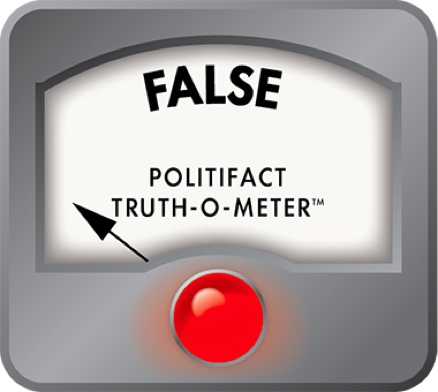
Just as LaHood’s pronouncement was premature — and False — this one is, too.
Our Sources
E-mails and interview, Cullen Werwie, spokesman, Scott Walker transition office. Nov. 23 and 29, 2010
E-mail, Olivia Alair, U.S. Department of Transportation, Nov. 23, 2010
Interview, Madison Mayor Dave Cieslewicz aide Chris Klein and communications director Rachel Strauch-Nelson, Nov. 23, 2010
Interview, U.S. Rep. Tom Petri (R-Wisconsin), Nov. 22, 2010
Milwaukee Journal Sentinel archives
USA Today, High-speed rail projects land in tug of war between governors, Nov. 23, 2010
WTMJ-AM (620), Charlie Sykes show, Nov. 24, 2010
STLyrics.com, "Ding Dong! The Witch is Dead" lyrics