The food pyramid was phased out in 2011, but it still gets hate. We looked back at why
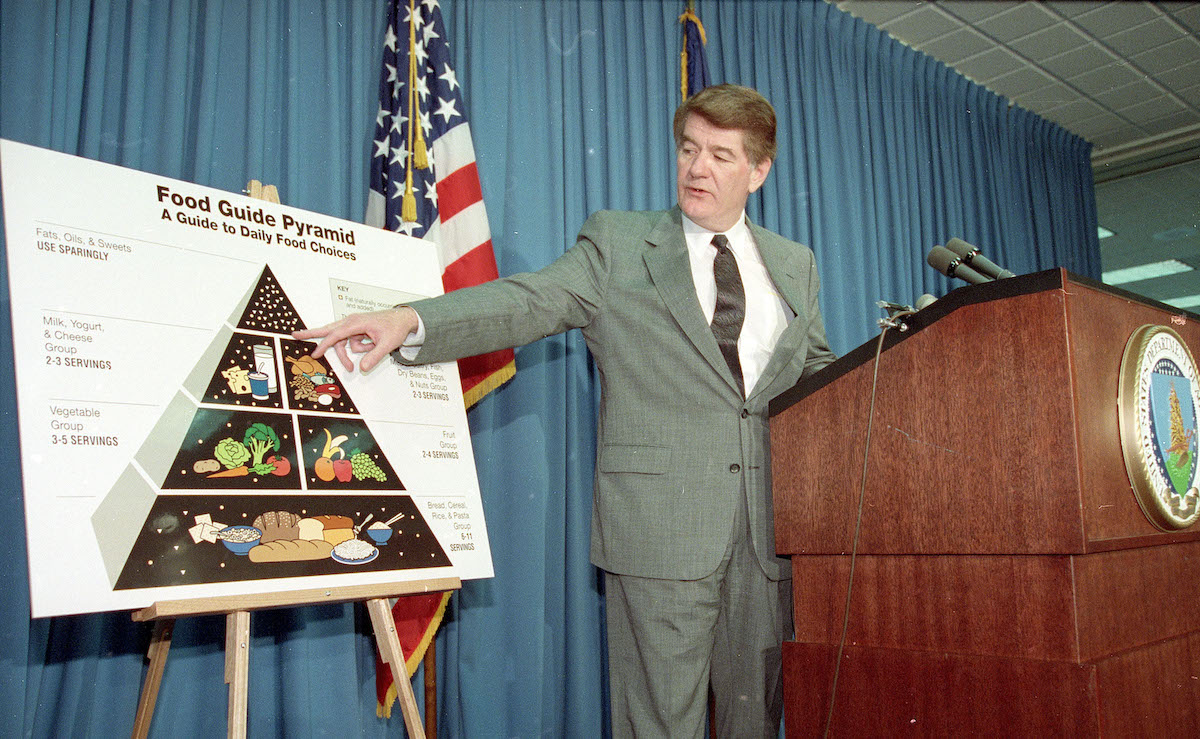
Maybe it was a faded poster in your school cafeteria or a worksheet in health class, but if you attended school in the 1990s or 2000s, you’re almost certainly familiar with the food pyramid.
The graphic dominated U.S. dietary education until 2011, when the federal government replaced it with MyPlate, which emphasized fruits and veggies as making up roughly half of a healthy diet.
Today, health leaders and some influencers are still lashing out at the old pyramid, with its grain-heavy focus, blaming it for some Americans’ poor health. As Health and Human Services Secretary Robert F. Kennedy Jr. announced December plans to unveil new federal dietary guidelines, we looked back at the old food pyramid. Was it really that bad? And did it actually change how we eat?
And what do experts (who aren’t trying to sell you something) say is a “healthy, balanced diet,” anyway?

Old, but not as old as the pyramids in Egypt
The iconic food pyramid didn’t make its debut in the U.S. until 1992, but its triangular building blocks date back further.
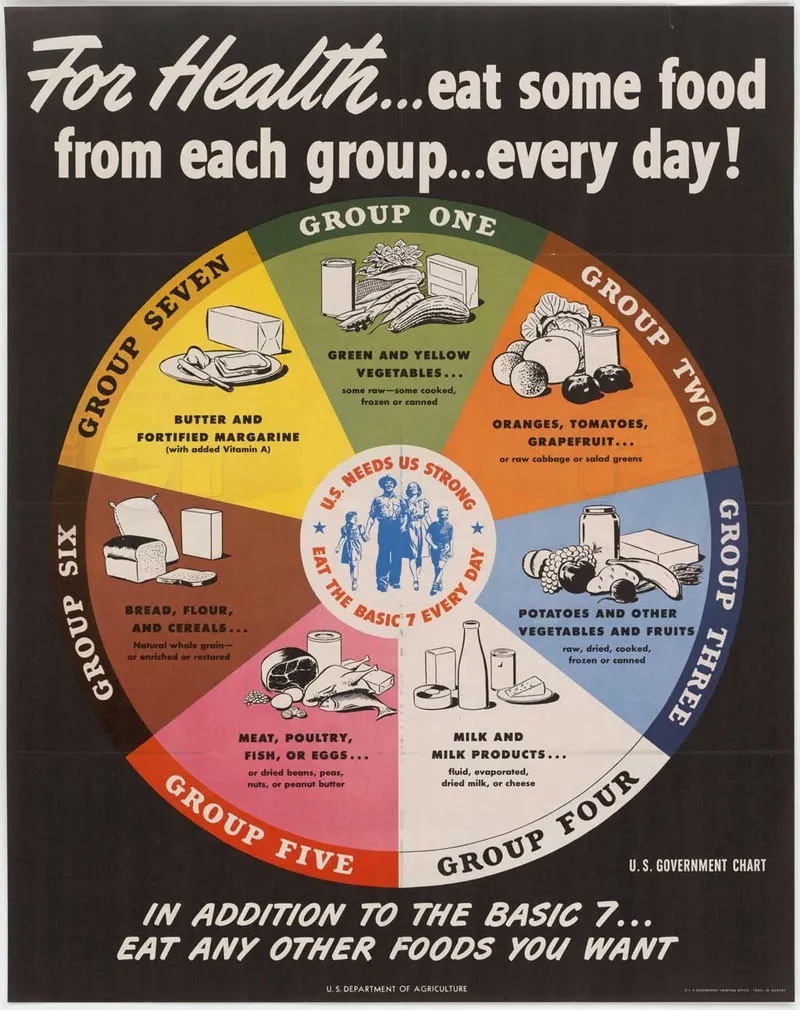
U.S. Department of Agriculture, “The Basic Seven,” 1943
The U.S. Department of Agriculture published its first dietary guidance in 1894 as a “Farmers’ Bulletin.” Over the next 80 years, as nutrition and food science understanding evolved, the department issued new guidelines on how to eat. In 1933, guidance advised families on how to get nutrients on a Depression-era budget. In 1943, the USDA’s “Basic Seven” food groups focused on healthy eating during wartime rationing. In 1956, USDA simplified its guidance to the “Basic Four” food groups.
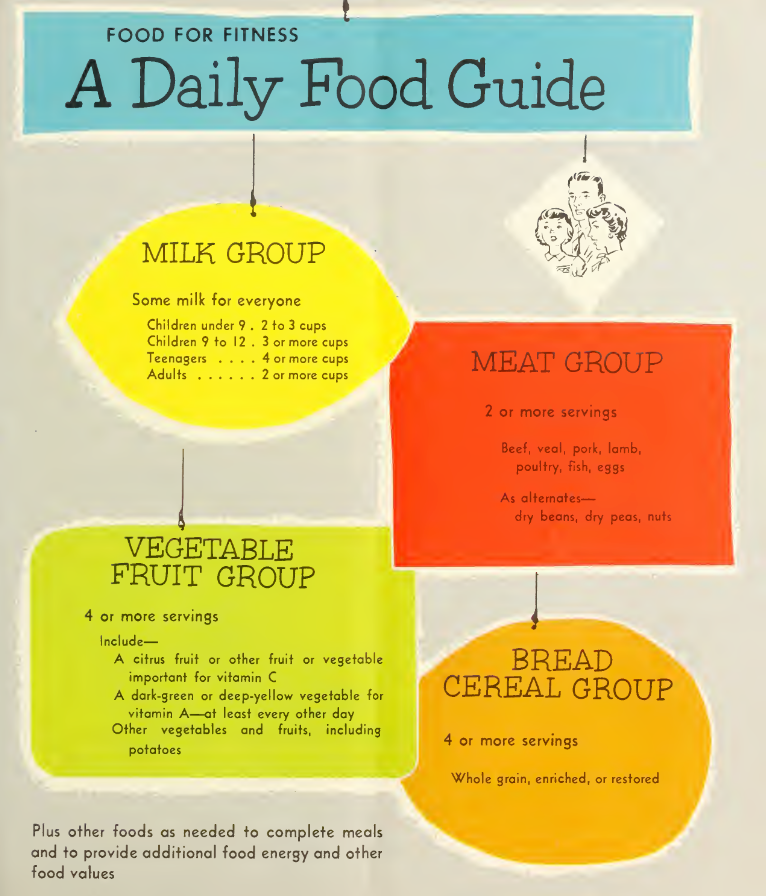
U.S. Department of Agriculture, “The Basic Four,” 1956
Up until the mid-20th century, nutrition guidance focused on vitamin deficiencies and making sure Americans got enough of certain foods. But as chronic health problems like obesity and cardiovascular disease began to rise in the 1950s and ‘60s, so did concerns about the American menu
In 1980, the USDA and HHS released the first set of dietary guidelines, which the USDA now publishes every five years. The food pyramid and MyPlate are simple, visual representations of these 100-plus-page guidelines over the years.
The dietary guidelines of the 1980s and 1990s focused heavily on reducing fats and cholesterol and eating more carbohydrates such as rice, corn and wheat.
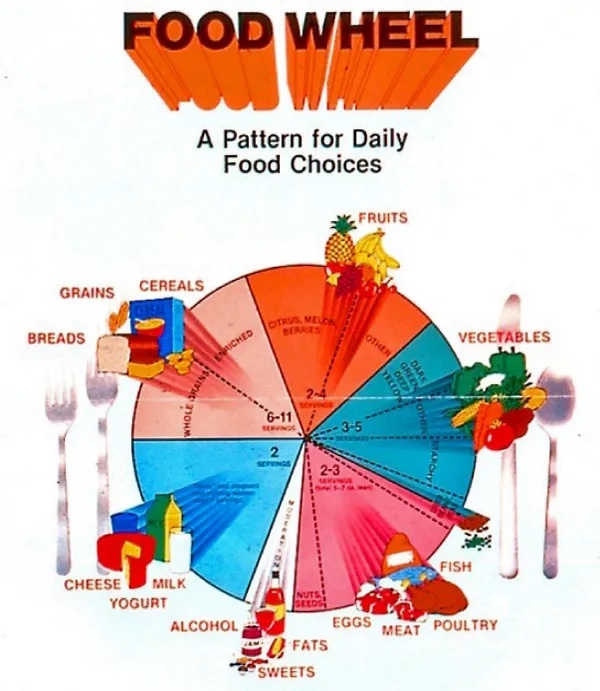
U.S. Department of Agriculture, “Food Wheel,” 1984
“Carbohydrates are especially helpful in weight-reduction diets because, ounce for ounce, they contain about half as many calories as fats do,” read the 1985 dietary guide.
Fats, sugars and oils appeared at the 1992 Food Guide Pyramid’s top “use sparingly” category, and grains formed the base with a recommended six to 11 daily servings.
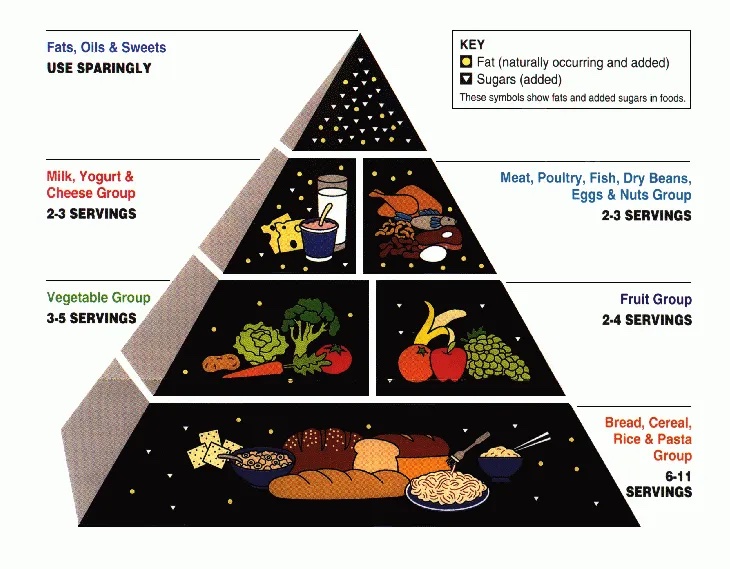
U.S. Department of Agriculture, “Food Guide Pyramid,” 1992
“The pyramid wasn’t ‘bad,’ but it reflected the nutrition science of its time,” said Debbie Petitpain, registered dietician and Academy of Nutrition and Dietetics spokesperson.
The thinking at the time was that low-fat diets were protective against heart disease, and carbohydrates were a healthier alternative to fatty foods. “It turned out that was wrong,” said Marlene Schwartz, University of Connecticut food policy and health professor.
Research around the turn of the century revealed the reality was more complicated. Added sugars and refined grains also contribute to cardiovascular and metabolic diseases, and not all fats are equally bad for us. “Unsaturated fats from foods like olives, nuts, and seeds can be protective for heart health,” Petitpain said.
Reflecting this shift, the 2005 dietary guidelines ditched the grain-heavy focus in favor of a more even breakdown across the food groups. For a 2,000-calorie diet, federal guidance recommended six ounces of grains (half of them whole grains), two and a half cups of vegetables, two cups of fruits, five and a half ounces of lean meat or beans and three cups of milk.
The USDA ditched the pyramid’s hierarchical sections in favor of vertical colored stripes and added a person walking up the side to represent physical activity. The visual was confusing and hard to parse.

Our Sources
Interview with Marlene Schwartz, University of Connecticut food policy and health professor, Oct. 28, 2025
Email Interview with Debbie Petitpain, registered dietician and Academy of Nutrition and Dietetics spokesperson, Oct. 28,2025
Email Interview with Dr. Dariush Mozaffarian, Tufts University nutrition science professor, Oct. 29, 2025
Email interview with Marion Nestle, Professor of Food, Nutrition, and Public Health, Emerita at NYU, Oct. 28, 2025
DietaryGuidelines.gov, Dietary Guidelines for Americans, 1990, Nov. 1990
International Journal of Health Services, Food lobbies, the food pyramid, and U.S. nutrition policy, 1993
DietaryGuidelines.gov, Dietary Guidelines for Americans, 2000, 2000
Obesity Research, Trends in Energy Intake in U.S. between 1977 and 1996: Similar Shifts Seen across Age Groups, Sept. 2012
CDC Morbidity and Mortality Weekly Report (MMWR),Trends in Intake of Energy and Macronutrients --- United States, 1971--2000, Feb. 6, 2004
DietaryGuidelines.gov, Dietary Guidelines for Americans, 2005, 2005
NCBI Bookshelf, Role and Purposes of the Dietary Guidelines for Americans: Evaluation and Findings, Nov. 16, 2017
The Journal of Nutrition, Americans do not meet federal dietary recommendations, Oct 2010
Today I Found Out, Who Invented the Food Pyramid?, Sept. 27, 2013
The American Journal of Medicine,The epidemic of the 20(th) century: coronary heart disease, May 2014
NPR (The Salt), The U.S. Doesn't Have Enough Of The Vegetables We're Supposed To Eat, Sept. 19, 2015
Time Magazine, Experts Say Lobbying Skewed the U.S. Dietary Guidelines, Jan. 8, 2016
ABC News, How Government Dietary Guidelines Have Changed Over the Years, Jan. 7, 2016
NPR (The Salt), Wheels, Pyramids And Plates: USDA's Struggles To Illustrate Good Diet, Jan. 13, 2016
Journal of the Academy of Nutrition and Dietetics American Diet Quality: Where It Is, Where It Is Heading, and What It Could Be, Feb. 2016
Pew Research Center, What’s on your table? How America’s diet has changed over the decades, Dec. 13, 2016
Harvard T.H. Chan School of Public Health,A visual history of food guides, Oct. 24, 2013
Science and Politics of Nutrition,History of modern nutrition science—implications for current research, dietary guidelines, and food policy, June 13, 2018
PBS SoCal, Revisiting the Evils of the Food Pyramid, Jan. 26, 2015
JAMA, Trends in Dietary Carbohydrate, Protein, and Fat Intake and Diet Quality Among US Adults, 1999-2016, Sept. 2019
UC Berkeley Research News, Berkeley scientist looks back on American nutritional guidelines, Aug. 28, 2025
Center for Science in the Public Interest (CSPI), What Are the Dietary Guidelines and Why Do They Matter?, July, 30 2025
The New York Times,Food Industry Influence Could Cloud the U.S. Dietary Guidelines, a New Report Says, Oct. 4, 2023
USDA Economic Research Service (Amber Waves), Food Consumption and Nutrient Intake Trends Emerge Over Past Four Decades, Aug. 28, 2024
DietaryGuidelines.gov,Table: History of Dietary Guidance Development in the United States and the Dietary Guidelines for Americans – A Chronology, accessed Oct. 29, 2025
DietaryGuidelines.gov, History of the Dietary Guidelines, accessed Oct. 29, 2025
DietaryGuidelines.gov, Who’s Involved in Updating the Dietary Guidelines, accessed Oct. 29, 2025
NPR, RFK Jr.'s new dietary guidelines could be controversial. Here's what to watch for, Oct. 8, 2025
Annual Review of Nutrition, Make America Healthy, Again? The Past, Present and Future of Dietary Guidelines, Aug. 21, 2025
DietaryGuidelines.gov, HEI Over Time (2020-2025 DGA), 2020
CDC National Center for Health Statistics (NCHS), Awareness of the MyPlate Plan: United States, 2017–March 2020 , Nov. 29, 2022
Brigham and Women's Hospital (BWH), U.S. Food Pyramid Compared to Other Food Guides, accessed Oct. 29, 2025
DietaryGuidelines.gov,Evolution of the Dietary Guidelines, accessed Oct. 29, 2025
MyPlate.gov, MyPlate Plan Results for a 14-99 year old with 2000 calorie plan, accessed Oct. 30, 2025
WebMD, Vegetarian and Vegan Diet Overview, Dec, 29, 2024
American Journal of Clinical Nutrition, "Trends in energy intake among adults in the United States: findings from NHANES," April 2013
Congress.gov, "Healthy, Hunger-Free Kids Act of 2010 111th Congress (2009-2010)," Dec. 13, 2010
Journal of Nutrition Education and Behavior, "Awareness and Use of MyPlate Among US Adults With Young Children," Aug. 2024
USDA, "Food Consumption, Nutrient Intakes, and Diet Quality - Summary Findings," May 6, 2025
British Journal of Nutrition, "Trends in Dietary Fat Intake and High-Fat Foods from 1991-2008 in the Framingham Heart Study participants," July 18, 2025
USDA, "Dietary Quality by Food Source and Demographics in the United States, 1977–2018," March 2023
Calley Means, "X post," Oct. 26, 2025
Fox News, "American nutrition a top priority for MAHA as the 'Knowledge Doc' weighs in," Feb 21, 2025
Harvard University, "The sweet danger of sugar," Jan. 6, 2022
American Heart Association, "Get to Know Grains: Why You Need Them, and What to Look For," June 25, 2024
Medical News Today, "Diets high in refined grains increase heart attack risk," Feb. 27, 2021
Smithsonian Magazine, "Grab Your Fork and Travel Back in Time With These Old USDA Dietary Guidelines," Jan. 7, 2016
MyPlate.gov, accessed Oct. 31, 2025