At 100 days, Trump’s administration struggles to achieve the Russia-Ukraine peace he promised
While campaigning, President Donald Trump repeatedly pledged to negotiate an end to the Russia-Ukraine war within 24 hours of his inauguration. Now, more than 2,300 hours into his second term, the war continues.
On April 22, Trump told Time magazine he’d exaggerated how fast he could end the war to make a point.
“Obviously, people know that when I said that, it was said in jest, but it was also said that it will be ended,” he said.
Trump’s promise is one of 75 that PolitiFact is tracking on the MAGA-Meter, just as we did with promises by Barack Obama, Trump during his first term, and Joe Biden.
When asked about the administration’s efforts to end the war, a White House spokesperson pointed us to Trump’s public comments.
Since January, Trump has echoed false Russian talking points, such as the claim that Ukrainian President Volodymyr Zelenskyy “started” the war in Ukraine with Russia. Trump has also expressed a desire to end the war quickly, regardless of Ukraine’s territorial losses, and added the U.S. to a short list of countries that are willing to recognize Russia’s 2014 annexation of Crimea.
Trump administration officials in April repeatedly said the U.S. might walk away from peace talks entirely.
Trump’s main achievement toward ending the war was getting the negotiations started, said Lance Janda, a Cameron University history professor and social sciences department chair. Progress is limited, though, because his main strategy for ending the war has been pressuring Ukraine to make concessions to Russia.
The administration’s effort to end the war — and U.S. threats to exit negotiations — intensified as Trump approached his second term’s 100-day mark. In recent days, Trump issued a public rebuke of Russian attacks on Ukraine’s capital and had a private, face-to-face meeting with Zelenskyy before Pope Francis’ funeral.
The administration’s efforts since Trump’s original 24-hour deadline have included meetings with Russian and Ukrainian officials in Washington D.C., Paris and Riyadh, Saudi Arabia. But so far, no peace deal has been negotiated.
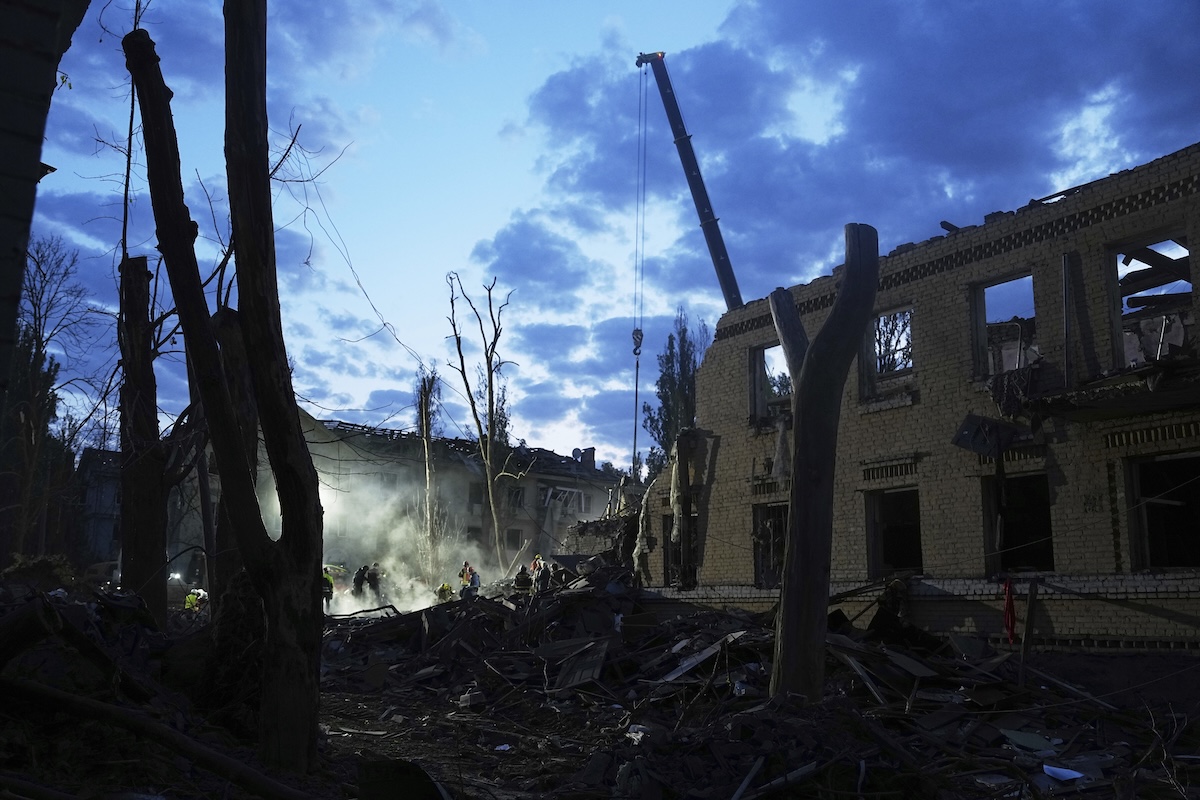
Rescue workers clear the rubble after a Russian ballistic missile attack in Kyiv, Ukraine, April 24, 2025. (AP)
In April, Trump officials signaled the U.S. might abandon negotiations amid Crimea recognition dispute
On April 27, U.S. Secretary of State Marco Rubio said the talks were closer than they had been since Russia invaded Ukraine, but the two sides were “not there yet.”
“This week is going to be a really important week in which we have to make a determination about whether this is an endeavor that we want to continue to be involved in, or if it’s time to sort of focus on some other issues some other issues that — that are equally, if not more, important in some cases,” Rubio said.
This came after Rubio’s April 18 assertion that the deadline for reaching a peace deal before the U.S. would walk away was “a matter of days, not a matter of weeks.” Shortly after that comment, U.S. officials proposed recognizing Russia’s illegal 2014 annexation of Crimea as part of a potential peace agreement.
Erik Herron, a political science professor at West Virginia University, said the proposal required concessions from Ukraine and the U.S., but “I have not heard of any concessions from the Russian side, and this is a recurring theme of the Trump administration’s approach.”
Trump also told Time magazine April 22 that “Crimea will stay with Russia.”
Harley Balzer, a Georgetown University government and international affairs emeritus professor, said that position puts the U.S. alongside Cuba, Nicaragua, Venezuela, Syria, Afghanistan and North Korea.
Zelenskyy rejected the idea of Ukraine legally recognizing Russia’s occupation of Crimea, the Kyiv Independent reported April 22.
“There is nothing to talk about,” Zelenskyy said. “This violates our constitution. This is our territory, the territory of the people of Ukraine.”
In 2014, Russia seized Crimea, a Ukrainian peninsula on the northern coast of the Black Sea. The annexation — a precursor to Russia’s 2022 full-scale invasion of Ukraine — followed protests in Kyiv that removed pro-Russia former Ukrainian President Viktor Yanukovych. At the time, then-President Barack Obama condemned Russia’s actions.
In an April 23 Truth Social post, Trump said Zelenskyy’s refusal to consider the proposal to recognize Russian authority over Crimea was “very harmful to the Peace Negotiations with Russia.”
“Nobody is asking Zelenskyy to recognize Crimea as Russian Territory but, if he wants Crimea, why didn’t they fight for it eleven years ago when it was handed over to Russia without a shot being fired?” Trump wrote, saying Zelenskyy’s “inflammatory statements” were making it difficult to end the war.
The same day, Vance again warned the U.S. might walk away from negotiations.
Amid the April talks, Russia attacked Ukraine’s capital, killing at least 12 people and injuring about 90 others, according to The Associated Press. Trump issued a rare reprimand to Russian President Vladimir Putin: “I am not happy with the Russian strikes on KYIV. Not necessary, and very bad timing. Vladimir, STOP!”
Since the U.S. engaged in the peace talks, Putin announced a temporary 30-hour Easter ceasefire and plans to observe a temporary ceasefire May 8-10 to commemorate the end of World War II. During Putin’s initial Easter truce, which started April 19, the fighting was quieter on the front lines, the BBC reported. Ultimately, though, Ukrainian officials said Russia continued its attacks on Ukraine during the ceasefire; Russian authorities said Ukraine’s army broke the truce.
As of April 28, no peace deal had been reached.
“This is going to be great television”: U.S.-Ukraine leaders clash in Oval Office
One of the most noteworthy moments during the first 100 days of Trump’s efforts to end the war was when an Oval Office meeting among Trump, Zelenksyy and Vice President JD Vance deteriorated into a televised argument.
Zelenskyy visited the White House on Feb. 28 to sign a deal that would give the U.S. access to Ukraine’s mineral deposits as a means of Kyiv repaying the U.S. for aid. Experts said the deal represented another Trump administration focus during the negotiations: securing U.S. economic benefits from Ukraine.
Vance accused Zelenskyy of litigating disagreements in front of the American media and falsely said Zelenskyy had not thanked the U.S. for its support of Ukraine.
As Zelenskyy reiterated that he’d said thank you, Trump grew visibly upset, accusing Zelenskyy of “gambling with World War III.”
Trump also signaled that he expected Ukraine to accept a ceasefire even without the security guarantees Zelenskyy said were important earlier in the meeting. Trump argued that Russia wouldn’t break a ceasefire because “they respect me.” Then he turned the conversation back toward U.S. support for Zelenskyy.
“I don’t think you’d be a tough guy without the United States,” Trump said. “And your people are very brave. But you’re either going to make a deal or we’re out. And if we’re out, you’ll fight it out. I don’t think it’s going to be pretty, but you’ll fight it out.”
Trump clasped his hands together and ended the meeting by declaring: “This is going to be great television, I will say that.”
Zelenskyy left the White House without signing the minerals agreement. Trump said on Truth Social that he believed Zelenskyy was “not ready for Peace if America is involved.”
Zelenskyy said March 1 on X that Ukraine is grateful for U.S. support and wants peace.
“We are ready to sign the minerals agreement, and it will be the first step toward security guarantees,” he wrote. “But it’s not enough, and we need more than just that. A ceasefire without security guarantees is dangerous for Ukraine.”
Two days later, a White House official told CNN that Trump ordered a pause on shipments of U.S. military aid to Ukraine until Trump was satisfied Zelenskyy was sufficiently committed to peace talks. CIA Director John Ratcliffe said March 5 that the U.S. had also stopped intelligence sharing with Ukraine.
Throughout March, Trump and Putin discussed a potential pause of strikes against Ukrainian energy infrastructure, officials explored a tentative agreement to stop fighting in the Black Sea and the United States resumed its Ukraine military aid and intelligence sharing.
On April 17, Ukraine moved one step closer to finalizing a mineral deal with the U.S. But it was still unsigned as of April 25. Trump wrote that he hoped the deal would be signed immediately and said the overall Russia-Ukraine peace deal was “going smoothly.”
As of April 28, it was unclear whether the U.S. could broker a peace deal or would walk away. For now, we continue to rate Trump’s promise to negotiate an end to the Ukraine-Russia war within 24 hours of taking office Promise Broken.
PolitiFact Researcher Caryn Baird contributed to this report.
RELATED: Trump, Vance and Zelenskyy’s tense Oval Office meeting about Ukraine and Russia, fact-checked
RELATED: Did Ukraine start its war with Russia, as President Donald Trump said? No, Russia invaded
Our Sources
Email interview with Lance Janda, history professor and department of social sciences chair at Cameron University, April 24, 2025
Email interview with Erik Herron, political science professor at West Virginia University, April 24, 2025
Email interview with Harley Balzer, government and international affairs emeritus professor at Georgetown University, April 24, 2025
Email interview with Kristina Hook, conflict management professor at Kennesaw State University, April 28, 2025
PolitiFact, Russia-Ukraine war continues despite passage of Trump's first 24 hours in office, Jan. 22, 2025
Factbase, Speech: Donald Trump Holds a Political Rally in Waco, Texas, March 25, 2023
Factbase, Speech: Donald Trump Addresses the North Carolina GOP Convention in Greensboro, June 10, 2023
Factbase, Remarks: Donald Trump Speaks to Supporters in Bedminster After His Miami Indictment, June 13, 2023
Factbase, Speech: Donald Trump Addresses a Republican Women's Lunch in Concord, New Hampshire, June 27, 2023
The Washington Post, U.S. proposes recognizing Crimea as Russian ahead of new round of talks, April 22, 2025
PolitiFact, Trump, Vance and Zelenskyy's tense Oval Office meeting about Ukraine and Russia, fact-checked, Feb. 28, 2025
The Associated Press, Trump's Oval Office thrashing of Zelenskyy shows limits of Western allies' ability to sway US leader, March 1, 2025
Ukrainian President Volodymyr Zelenskyy X thread, March 1, 2025
The Associated Press, Zelenskyy leaves White House without signing minerals deal after Oval Office blowup, Feb. 28, 2025
The Associated Press, Trump says Zelenskyy is coming to the White House to sign US-Ukraine critical minerals deal, Feb. 26, 2025
CNN, Trump pauses military aid to Ukraine after Oval Office argument with Zelensky, White House official says, March 3, 2025
PolitiFact, Did Ukraine start its war with Russia, as President Donald Trump said? No, Russia invaded, Feb. 19, 2025
Euronews, Trump holds separate phone calls with Putin and Zelenskyy on starting Ukraine negotiations, Feb. 12, 2025
Donald Trump's Truth Social post, Feb. 12, 2025
The New York Times, Trump Says Call With Putin Is Beginning of Ukraine Peace Negotiations, Feb. 12, 2025
The Guardian, Joe Biden calls Vladimir Putin a war criminal – video, March 16, 2022
CNN, After Putin call, Trump says negotiations to end Ukraine war will start 'immediately,' Feb. 12, 2025
Ukrainian President Volodymyr Zelenskyy's X post, Feb. 12, 2025
The Guardian, US and Russia agree to explore mutual opportunities of end to Ukraine war, Feb. 18, 2025
The Associated Press, Russia and US agree to work toward ending Ukraine war in a remarkable diplomatic shift, Feb. 18, 2025
CNN, Trump falsely calls Zelensky 'a dictator' after Ukraine's leader accuses him of living in 'disinformation space,' Feb. 19, 2025
The Guardian, Ukraine 'may be Russian some day', Trump says ahead of Zelenskyy meeting with Vance, Feb. 11, 2025
The Associated Press, What they said: Trump, Zelenskyy and Vance's heated argument in the Oval Office, Feb. 28, 2025
C-SPAN, Full Meeting between President Trump, VP Vance and Ukrainian President Zelensky in Oval Office, Feb. 28, 2025
Michael McFaul's Substack, Why Is Trump Acting like Putin's Agent? April 23, 2025
The Associated Press, Zelenskyy leaves White House without signing minerals deal after Oval Office blowup, Feb. 28, 2025
Donald Trump's Truth Social post, Feb. 28, 2025
NPR, U.S. resumes Ukraine military aid and intelligence sharing as Kyiv approves ceasefire, March 12, 2025
CNN, Zelensky invades Trump's 'disinformation space' — and it could really hurt Ukraine, March 1, 2025
DW, Ukraine: Trump says negotiators headed to Russia 'right now,' March 12, 2025
CBS News, U.S. has halted sharing intelligence with Ukraine, CIA director says, March 5, 2025
The Associated Press, Trump and Putin agree to an immediate ceasefire for energy infrastructure in Ukraine conflict, March 18, 2025
BBC, Putin agrees to halt strikes on Ukraine energy targets for 30 days, Kremlin says after call with Trump, March 18, 2025
The Associated Press, US says it brokered deal to end fighting in the Black Sea in talks with Ukraine and Russia, March 25, 2025
CNBC, Ukraine says it has signed the outline of a minerals deal with the U.S., April 18, 2025
France 24, Ukraine, US sign 'memorandum of intent' on critical minerals deal, April 17, 2025
CNN, US will abandon Ukraine peace efforts 'within days' if no progress made, Rubio warns, April 18, 2025
Donald Trump's Truth Social post, April 11, 2025
BBC, US special envoy meets Putin as Trump urges Russia to 'get moving' on Ukraine ceasefire, April 12, 2025
ABC News YouTube channel, JD Vance warns U.S. might 'walk away' from Russia-Ukraine deal, April 24, 2025
CBS News, Trump blasts Zelenskyy as Vance threatens to "walk away" from peace deal, April 23, 2025
The Kyiv Independent, Zelensky rules out recognizing Crimea as Russian, warns against playing into Putin's 'game,' April 22, 2025
CNN, Russia launches deadly aerial barrage on Ukraine as US pushes for peace plan, April 21, 2025
Time, Read the Full Transcript of Donald Trump's '100 Days' Interview With TIME, April 25, 2025
Euronews, Allies asked Kyiv 'not to provoke Russia' during Crimea annexation, Mejlis leader tells Euronews, April 24, 2025
BBC, Why Zelensky can't and won't give up Crimea, April 24, 2025
The Associated Press, In rare rebuke of Putin, Trump urges Russia to 'STOP!' after deadly attack on Kyiv, April 24, 2025
BBC, Attacks continue despite Putin's 'Easter truce' pledge, Zelensky says, April 20, 2025
National Review, Russia Announces Short 'Humanitarian' Truce in Ukraine to Celebrate End of World War II, April 28, 2025
The Associated Press, Russian attacks during Easter ceasefire declared by Putin killed 3 in Ukraine's Kherson region, April 21, 2025
The Associated Press, Shocked by US peace proposal, Ukrainians say they will not accept any formal surrender of Crimea, April 27, 2025
Al Jazeera, Ten years ago Russia annexed Crimea, paving the way for war in Ukraine, Feb. 20, 2024
Vox, Everything you need to know about the 2014 Ukraine crisis, Sept. 3, 2014
NPR, U.S. Steps In Response To Russia's Intervention In Ukraine, March 7, 2014
Donald Trump's Truth Social post, April 23, 2025
Donald Trump's Truth Social post, April 24, 2025
Donald Trump's Truth Social post, April 25, 2025
The Associated Press, Russian strike on Kyiv kills at least 12 in biggest attack on Ukrainian capital since last summer, April 24, 2025
The New York Times, Putin Orders 3-Day Truce in Ukraine Next Month, Kremlin Says, April 28, 2025
The New York Times, Ukraine Says Russia Broke Its Own Easter Truce Vow, April 20, 2025
CBS News, Trump met Ukraine's President Volodymyr Zelenskyy ahead of funeral of Pope Francis, April 27, 2025