Funding rises, but some veterans remain ineligible

Taking care of veterans has long enjoyed bipartisan support. In 2014, when Veterans Administration hospital officials were caught hiding long delays in treatment — delays that were tied to the deaths of some veterans — Congress and the Obama administration came up with new money to bolster the system.
During the campaign, candidate Donald Trump promised a full-court press to deliver for veterans.
“We are going to make sure every veteran in America has the choice to seek care at the Veterans Administration or to seek private medical care paid for by our government,” he posted on his campaign website.
Overall, the upward trends during the Obama administration continued under Trump. Trump’s budget called for an overall increase of 3.5 percent for the department, including more than a 6 percent hike for its medical programs.
The most significant move came when Trump signed a bipartisan bill that extended the Veterans Choice Program created in response to the 2014 scandal.
The Choice Program acknowledged that some veterans could get care faster and more easily if they used a private provider in their community. Washington put an initial $10 billion into the program. When that program was slated to end, Congress — without a single dissenting vote in the Senate or the House — moved to extend it and added an additional $2.1 billion. Trump approved the new money in August 2017. The continuing resolution passed in December included another $2.1 billion.
Providing high-quality care for veterans is always a work in progress. As veterans age, they increasingly turn to the VA for services. Meanwhile, VA facilities continue to work to fill open jobs for doctors, nurses and other care providers.
American Legion veterans affairs director Lou Celli told us that in terms of “getting people in the door at VA hospitals, there’s been no change.”
“But as for getting more veterans into community care, there’s been significant action in that direction.”
The diciest part of Trump’s promise is in his commitment to “every veteran.” The VA gives priority to soldiers whose health problems stem directly from their military service, and it has a hierarchy of priority groups. At the very bottom of the list, there are no slots for financially well-off veterans with no service-related claim.
For veteran groups such as the American Legion, this is a perennial sticking point.
“There has never been a situation in this or the previous administration where every veteran was eligible,” Celli said. “That hasn’t changed, nor have we heard discussions about opening VA care to all veterans.”
Based on a 2012 VA study, the Legion says nearly 7 million veterans are ineligible.
Trump and Congress have delivered more funds to provide health care to veterans. We’re waiting on more data on how many veterans have been getting care. Until then, we rate this promise In the Works.
Our Sources
Congress.gov. VA Choice and Quality Employment Act of 2017, Aug. 12, 2017
Veterans Affairs Department, Budget Authority, 2016-2018, May 23, 2017
Veterans Affairs Department, VA Utilization Profile FY 2016, November 2017
Veterans Affairs Department, Budget request for fiscal year 2018, June 14, 2017
Veterans Affairs Department, Statement From VA Secretary Robert A. McDonald, Sept. 1, 2016
Veterans Affairs Department, Priority Groups, Oct. 3, 2016
American Legion, Resolution on priority group access, Sept. 1, 2016U.S. Government Accountability Office, Preliminary Observations on Veterans' Access to Choice Program Care, March 7, 2017
Email interview, Fred Hannett, managing principal, Capitol Advantage, Dec. 27, 2017
American Legion, Testimony of Charles Schmidt before the Senate Veterans Affairs Committee, March 1, 2017
Disabled American Veterans, Statement of David Riley before the House and Senate Veterans Affairs Committees, March 1, 2017
U.S. Senate Veterans Affairs Committee, Examining the Veterans Choice Program and the Future of Care in the Community, June 7, 2017
The Atlantic, How VA Reform Turned Into a Fight Over Privatization, July 17, 2017
Interview, Lou Celli, national director veterans affairs and rehabilitation, American Legion, Dec. 21, 2017
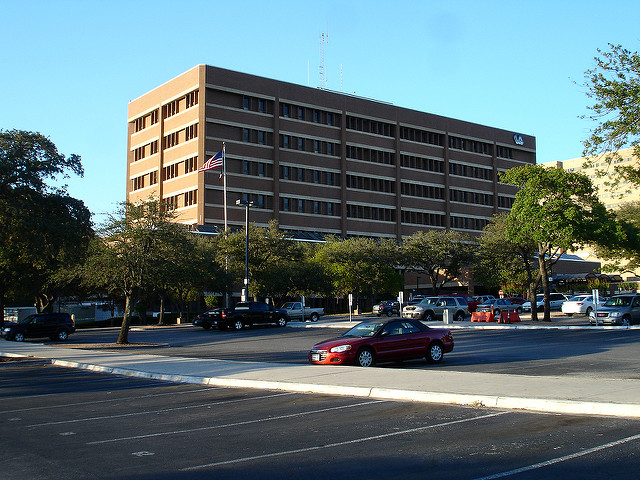
Photo: Audie L. Murphy VA Hospital, Vic Vargas, via Flickr Creative Commons